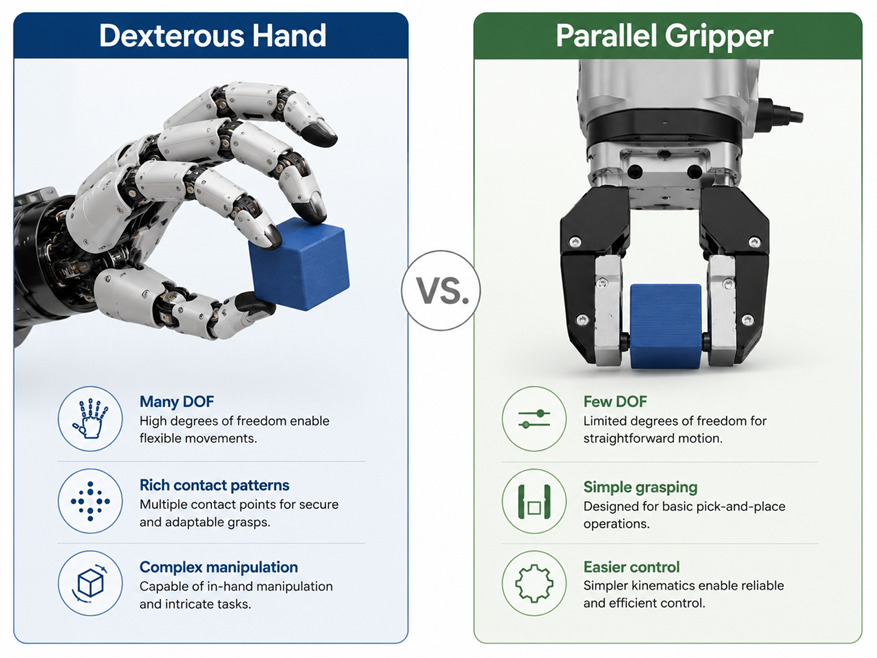
Dexterous manipulation is one of the most challenging problems in robotics. Compared with parallel-jaw grippers, multi-fingered dexterous hands introduce higher degrees of freedom, richer contact patterns, and more complex hand-object interaction geometry. A successful policy must reason about how the hand approaches the object, forms stable contact, and manipulates the object toward the desired goal.
This project explores 3D goal conditioning for dexterous manipulation. We use a hierarchical framework in which a high-level policy predicts a future dexterous hand configuration, and a low-level policy executes actions conditioned on the predicted goal. Our main focus is designing compact but expressive 3D goal representations that capture finger placement, palm position, and hand-object contact geometry.