Relative Depth Model Validation
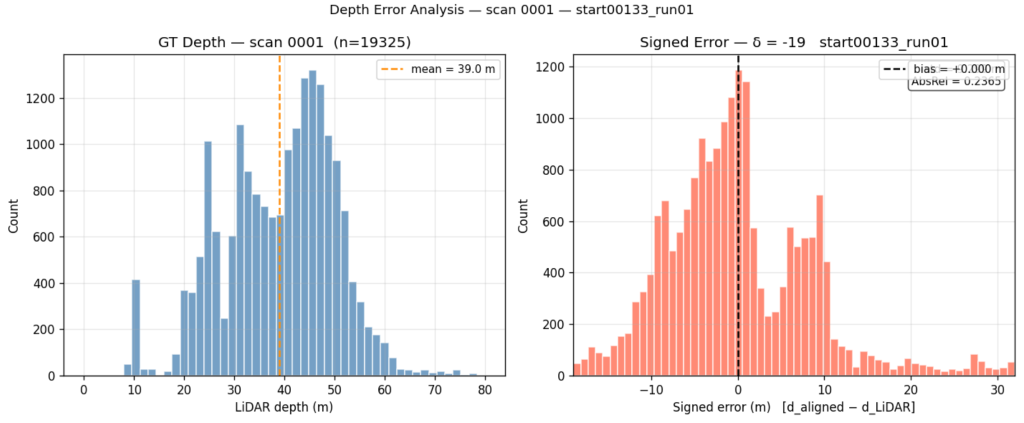
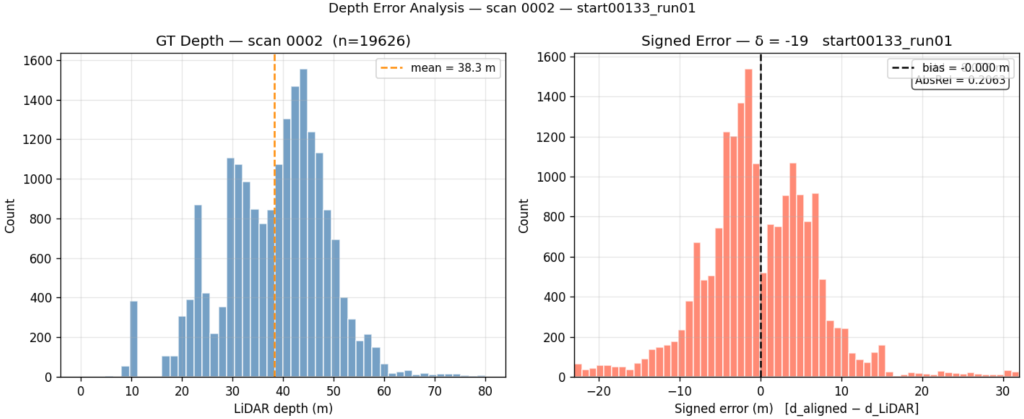
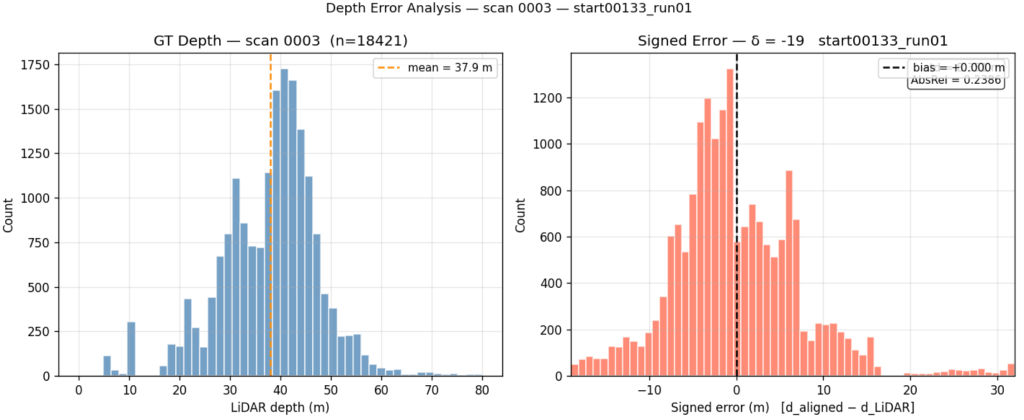
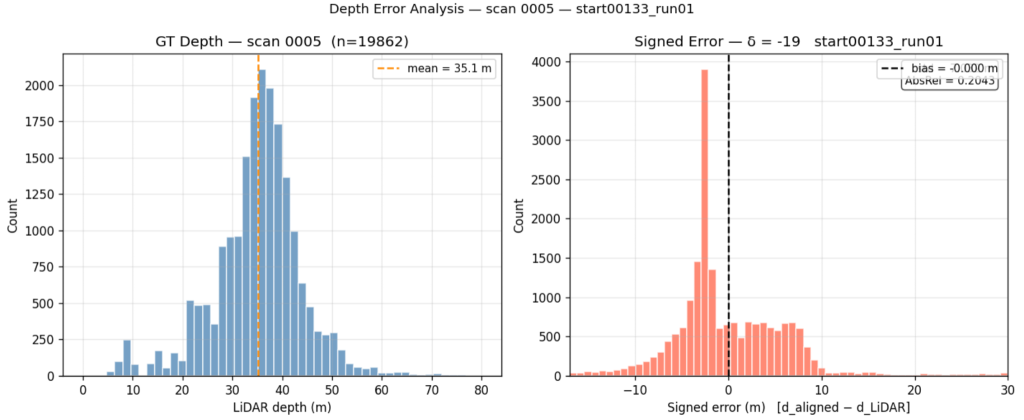
To validate model performance on real-world aerial datasets, we conducted inference using off-the-shelf depth models on captured drone flight data. An analysis of the ground truth distribution and signed relative error residuals was performed to characterize model bias. The results indicate an overall under-prediction bias in relative depth models; however, the concentration of error near the mean suggests that the predictions are structurally sound. This finding justifies the use of a linear scale-shift correction to align the model outputs with metric ground truth.
Metric Depth Model Analysis
Given these results, we need to ensure metric depth models do not perform adequately well, relative to the performance hit they provide running over commercial hardware (e.g., NVIDIA Jetson Orin). A common problem that hinders depth models video vs individual frames, is temporal consistency. As such, we evaluated the Depth-Anything-V2[1] (metric, large variant) and VideoDepth-Anything[2] (metric, ViT-large variant).
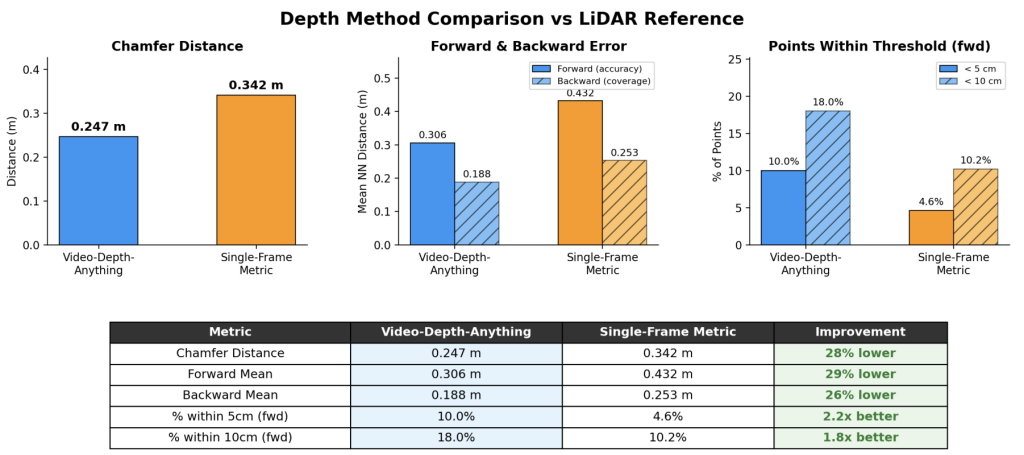
Depth Method Comparison vs. LiDAR Reference. Video-Depth-Anything outperforms Single-Frame Metric depth across all geometric metrics — 28% lower Chamfer Distance, 29% lower forward error, and 2.2× more points within 5 cm — yet neither model achieves sufficient accuracy to supplant a LiDAR-guided pipeline under edge hardware constraints.
As seen, the results, aren’t nearly good enough to replace lidar + relative depth models, especially considering the additional memory footprint and inference time required at runtime.
References
[1] L. Yang et al., “Depth Anything V2,” arXiv:2406.09414, 2024
[2] S. Chen et al., “Video Depth Anything: Consistent Depth Estimation
for Super-Long Videos,” arXiv:2501.12375, 2025.