Motivation
Near Earth Autonomy (NEA) aims to build products that enables safe and reliable beyond visual line of sight (BVLOS) flight. One particular product they are working on is Firefly, an modular system made to be attached consumer- and industry-grade UAVs.
Navigation through these environments is a fundamental challenge for small UAVs. Unlike larger platforms, the Firefly operates under strict SWaP constraints, limiting its sensor suite to what a lightweight airframe can physically carry and power. This rules out multi-camera rigs and traditional LiDAR, and pushes us toward a much leaner sensing modality, one where high-precision depth estimation becomes critical for safe flight.
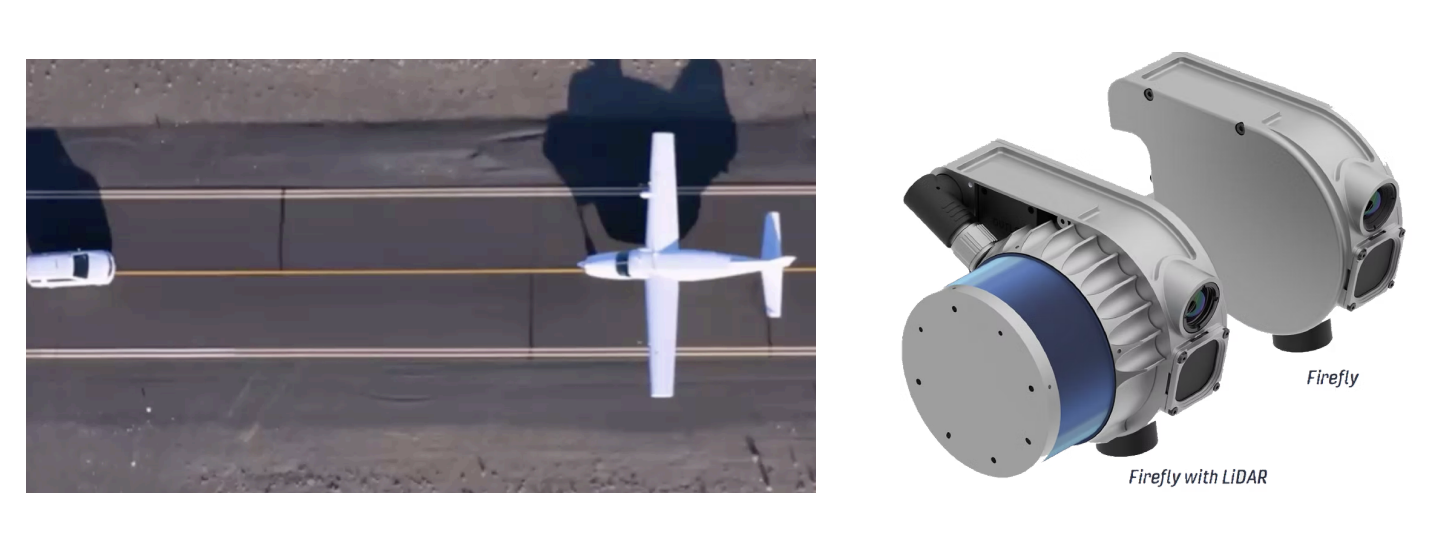
(Right) Firefly system showcased. (Left) Example system that may be attached to
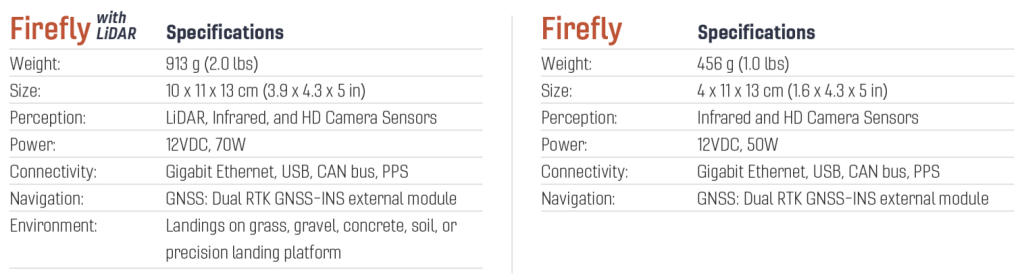
Firefly specifications
Yet monocular depth estimation is inherently ill-posed. A single 2D image can be produced from an infinite number of distinct 3D scenes, meaning scale and absolute distance cannot be recovered from image information alone [1, 2]. More precisely, the perspective projection from 3D world to 2D image is non-invertible, any point along a projection ray maps to the same image coordinate, leaving depth fundamentally unobservable from a single view without additional constraints [3]. Alternative approaches each carry their own limitations: stereo vision suffers from narrow baselines at small form factors, Structure from Motion requires careful motion conditions, and full LiDAR integration reintroduces the very payload and cost constraints we set out to avoid.
This brings us to the core research question: can SOTA monocular depth models be sufficient for obstacle avoidance and safe navigation? And if not, what is the minimal set of additional constraints we have to add to make the Firefly system work reliably?
References
[1] Eigen, D., Puhrsch, C., & Fergus, R. (2014). Depth Map Prediction from a Single Image using a Multi-Scale Deep Network. NeurIPS 2014, pp. 2366–2374. [arXiv:1406.2283]
[2] Bhoi, A. (2019). Monocular Depth Estimation: A Survey. arXiv preprint. [arXiv:1901.09402]
[3] Zeng, Z., Wu, Y., Park, H., et al. (2024). RSA: Resolving Scale Ambiguities in Monocular Depth Estimators through Language Descriptions. NeurIPS 2024. [arXiv:2410.02924]