
Quantitative Analysis
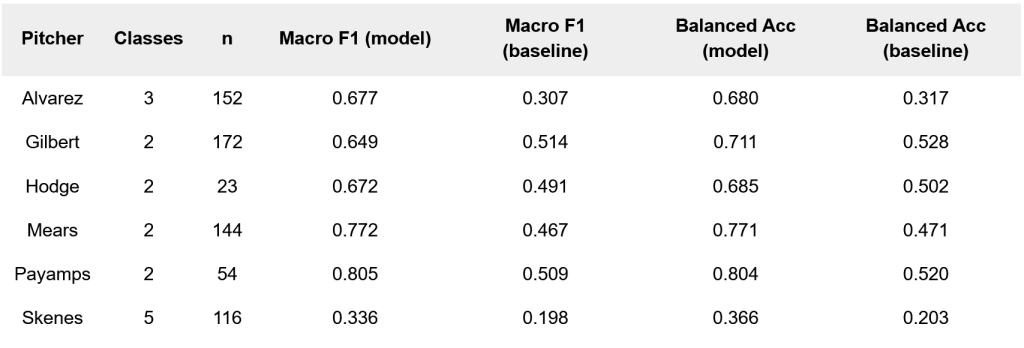
We evaluated the linear probe on six Pittsburgh Pirates pitchers, measuring macro F1 and balanced accuracy against a random baseline. Results are summarized in Table 1.
Overall, our model recovers a statistically meaningful signal in all six cases, with gains over baseline ranging from roughly 0.16 to 0.36 in balanced accuracy. Performance tends to decrease with the number of classes, consistent with the increased difficulty of the multi-class setting, and is more variable for pitchers with fewer training examples.
Interpretability
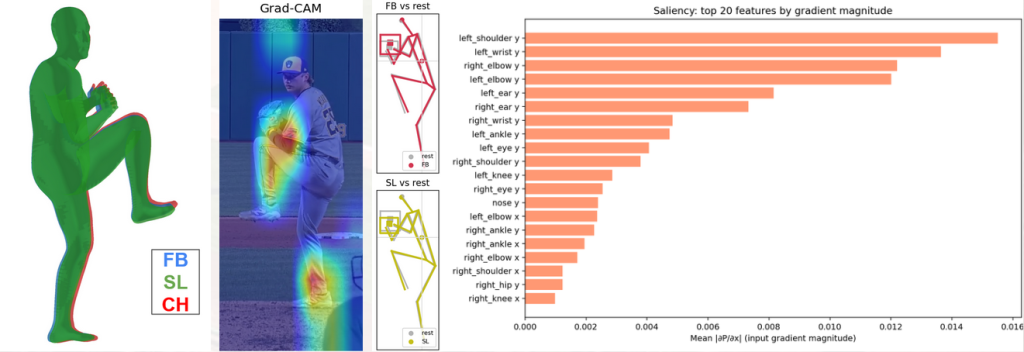
To understand what drives model predictions, we apply three complementary interpretability methods. Per-class pose overlays aggregate MLS keypoints across all clips of a given pitch type onto a canonical body mesh, making postural differences visually apparent. Grad-CAM heatmaps highlight which spatial image regions most influence each class prediction, providing a check that the model attends to biomechanically plausible areas rather than background artifacts. Finally, input gradient saliency over pose keypoint features identifies which joints carry the most discriminative signal.