4D Reconstruction From Monocular Video
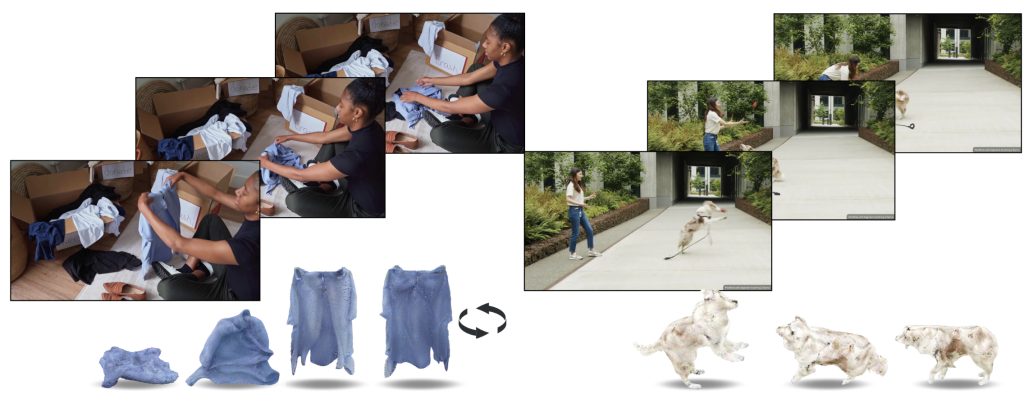
Authors: Manan Shah. Project Advisors: Yehonathan Litman, Xiaoxuan Ma, Nicolas Ugrinovic, Kris Kitani, Fernando De La Torre, Shubham Tulsiani
Introduction
One aspect of 3D scene understanding is to create visual systems that can faithfully reconstruct full 360-degree objects from monocular videos. We introduce a new method to recover “Complete 4D Reconstructions” of objects from a single, “in-the-wild” video.
The Challenge
Reconstructing moving objects from a single camera view is an open problem in computer vision. Some challenges that we aim to address:
- Deformable objects: Objects in videos may undergo large, unconstrained deformations, making it challenging for reconstruction methods based on fixed templates or rigid object assumptions to recover these deformations over time.
- Occluded objects: Objects of interest in the video may be occluded by other objects across time from a single view, making it harder to reconstruct the full object solely based on the observed video sequence.
- In-the-wild generalization: Real-world videos contain a diverse category of objects, making it harder to solely rely on a template-based approach for specific object classes such as humans or animals.
Our Approach
Our method bridges the gap between static 3D understanding and dynamic 4D motion. We utilize a state-of-the-art 3D reconstruction prior (SAM3D) and enhance it with three key innovations:
- Causal Latent Conditioning: We propagate information across video frames to ensure the object’s shape stays consistent over time.
- Deformable 3D Representation: We use a time-varying deformable 3D representation parametrized by sparse control nodes.
- Occlusion-Aware Supervision: To align the deformable representation with the input video, we use a rendering-based supervision while carefully taking care of occlusions and unobserved regions in the video.