TenebrioVision
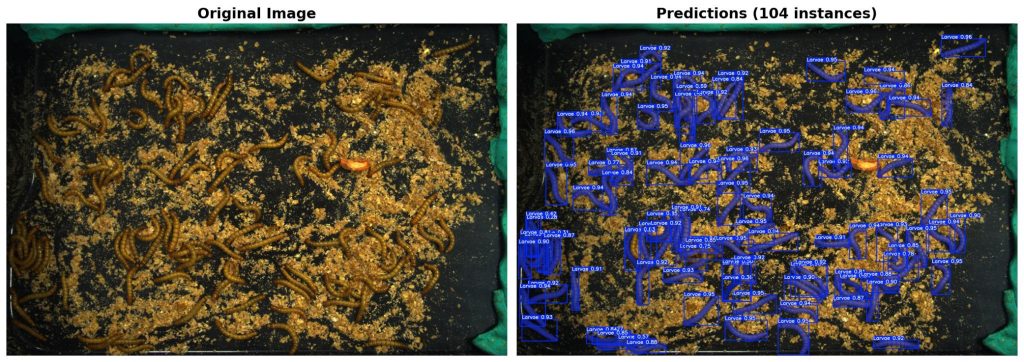
Tenebrio molitor (mealworm) is a promising sustainable source of energy and protein for human consumption. This dataset offers a significant advancement over previous work, providing a high-quality and large-scale dataset for insect-based computer vision tasks.
- High-Density Annotation: Features 10–100 annotations per image, totaling over 53,600+ instances with precise bounding boxes and instance segmentation masks.
- Superior Resolution: High-fidelity frames captured at 3088 x 2076 pixels for fine-grained feature extraction.
- Temporal Diversity: Curated from video sequences using 30-second interval sampling to ensure visual variety and reduce data redundancy.
SAM 3
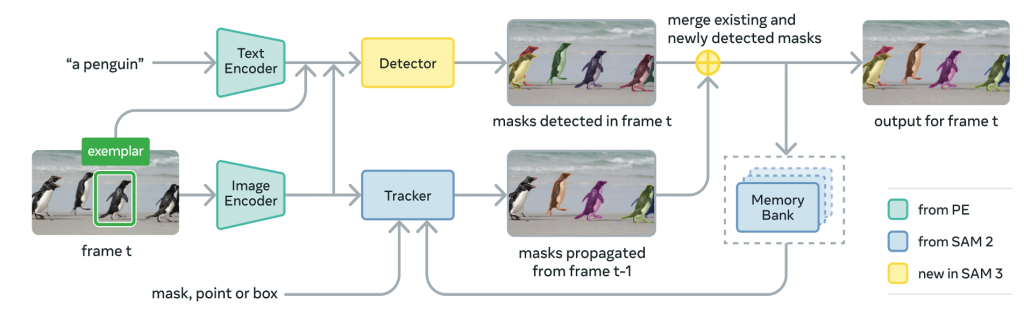
Building upon the success of its predecessors, SAM 3 represents a major leap in foundation models for segmentation. It addresses the fundamental limitations of static and video-based segmentation through several key innovations:
- Unified Detection & Tracking (DETR-style): SAM 3 introduces a novel DETR-style architecture that disentangles the operational conflict between tracking established targets and discovering new objects. By unifying these predictions, the model maintains high temporal consistency while remaining sensitive to newly appearing instances in complex environments.
- Massive Scale-up with Semantic Concepts: The training data has evolved from the class-agnostic masks of SAM 2 to the SA-Co dataset, which includes 1.4 billion masks across 4 million unique noun phrases. This enables true open-vocabulary segmentation based on a 22.4-million-node knowledge ontology.
- Zero-shot Generalization: With its refined architecture, SAM 3 demonstrates superior zero-shot ability, allowing it to segment unseen categories (such as specific life stages of Tenebrio molitor) with unprecedented precision.
DeepLabCut
DeepLabCut has a well-established lineage and saw early adoption from the neuroscience community. The model evolved from the earlier human-centric pose estimation models DeepCut and DeeperCut. Although the original paper was published in 2018, DeepLabCut has continued to grow into a robust toolkit for a variety of non-human animal pose estimation.
- Markerless pose estimation removed the need to attach physical markers to animals, which limited the skeleton that could be detected and involved substantial manual set-up
- Based on ResNet architecture pretrained on ImageNet with deconvolutional layers to maintain pixel-level predictions
- Many ablations:
- Training on single animal images and predicting on multi-animal images to evaluate generalization
- Varying the number of transfer learning training images to evaluate the data requirements
- Training with a subset vs. all body parts to evaluate the value of additional joint context
- Recent work with foundation models have produced “SuperAnimal” models that exhibit strong zero-shot performance on 40+ quadrupeds (e.g. dogs, cats, elephants, giraffes)