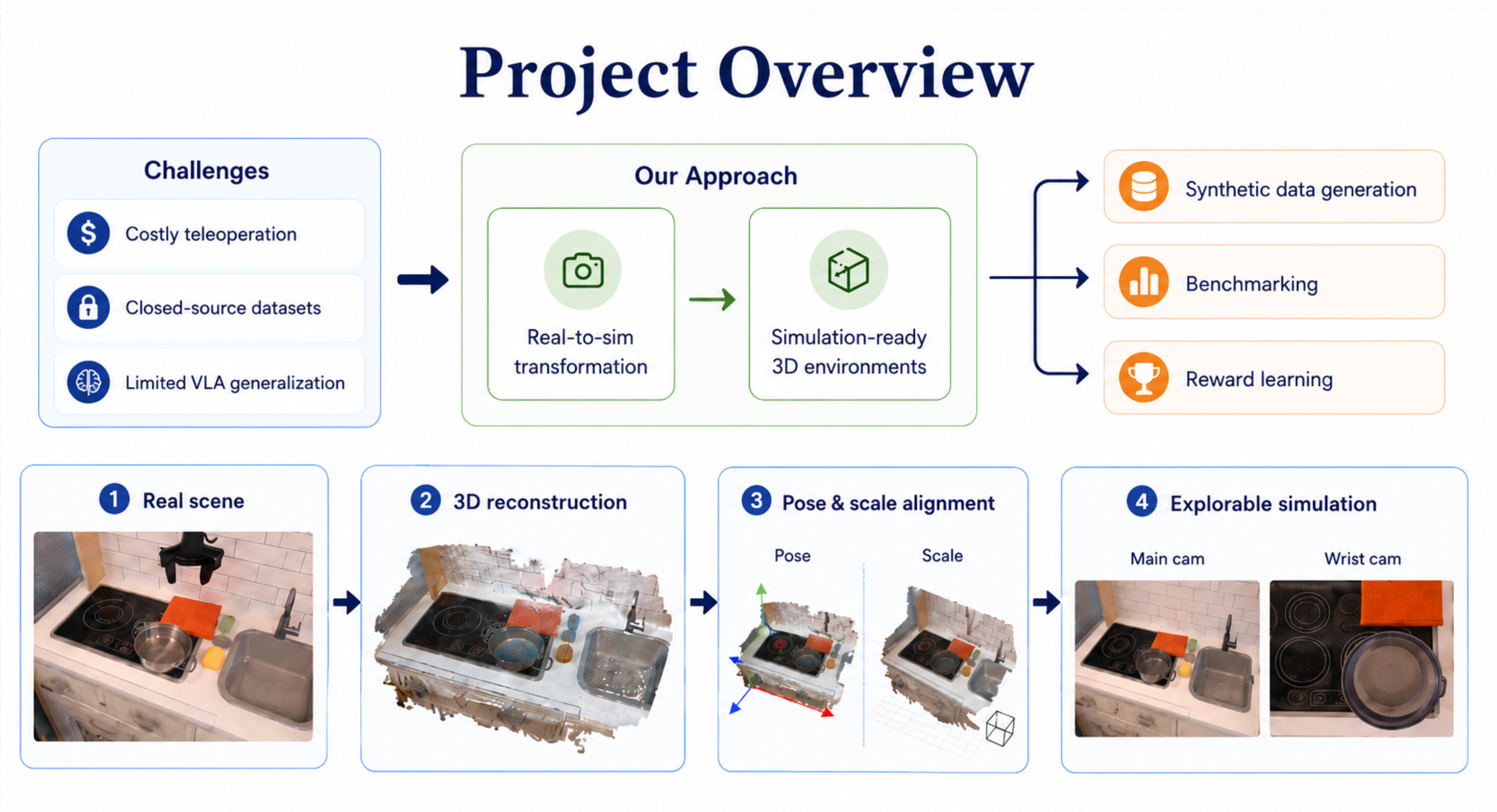
Robotic manipulation faces a major scalability challenge: learning effective policies requires large amounts of diverse demonstration data, but real-world teleoperation is costly, time-intensive, and difficult to scale. Many real-world robot datasets are also closed-source, limiting accessibility and reproducibility. Meanwhile, Vision–Language–Action models often struggle to generalize beyond their training environments and typically require significant fine-tuning before deployment in new settings.
This project explores how simulation can help address these limitations. We focus on building realistic and simulation-ready environments from real-world visual observations, then using these environments as a foundation for scalable synthetic data generation, benchmarking, reward learning, and future VLA training.