We survey recent works in HOI and HSI generation, identifying key gaps and open challenges that inform our design decisions.
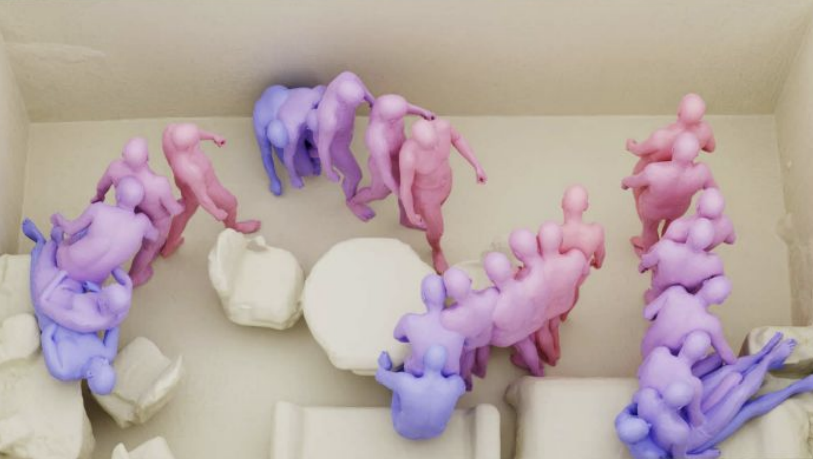
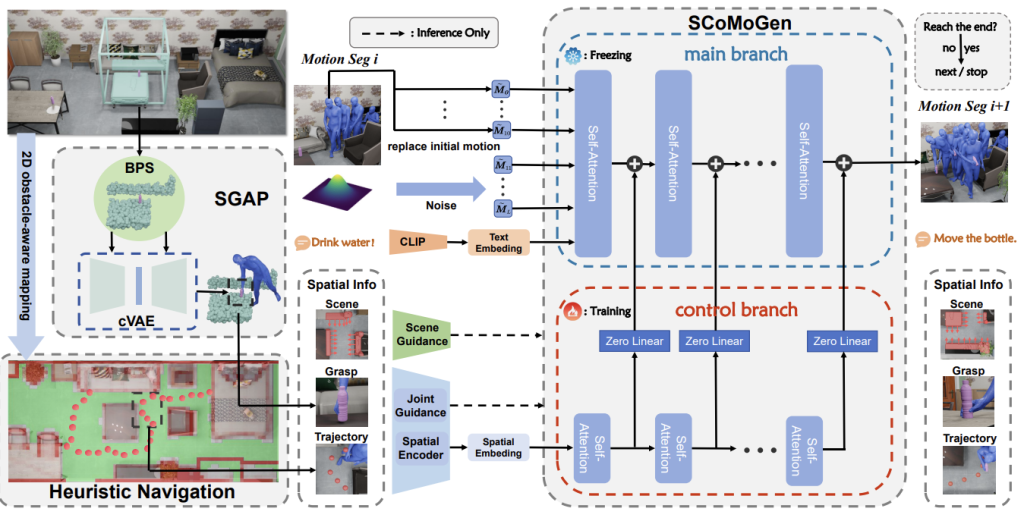
HOSIG synthesizes full-body human-object-scene interactions through hierarchical scene perception, combining scene-aware grasp pose generation, heuristic navigation planning, and a trajectory-controlled diffusion model for finger-level accurate, arbitrary-length motions.
- Method: Decomposes the task into grasp pose generation (CVAE), A* navigation for locomotion, and a scene-guided diffusion model for full trajectory generation.
- Limitations: Lacks bimanual and dexterous manipulation, supports limited object diversity, and provides no effective interface for interaction sequencing.
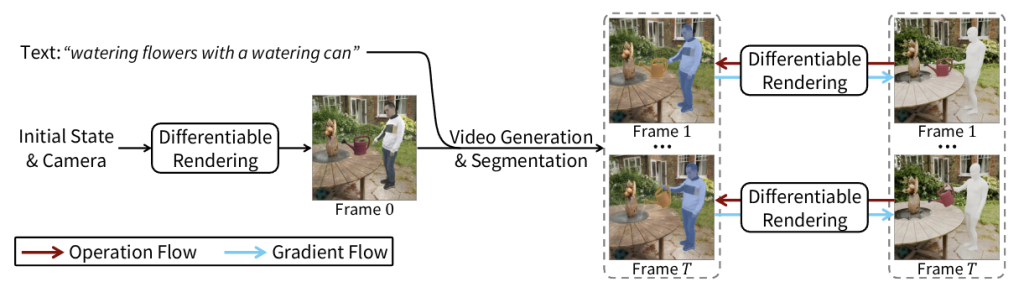
ZeroHSI enables zero-shot 4D human-scene interaction synthesis without paired motion capture data, by distilling interactions from video generation models (e.g., KLING) and reconstructing them into 3D motions via differentiable Gaussian rendering.
- Method: Zero-shot 4D HSI through video model distillation, with per-frame 2D-to-4D lifting and optimization, supporting both static scenes and dynamic objects.
- Limitations: Text-only control with no spatial conditioning or navigation markers, and requires per-scene optimization rather than a feedforward approach
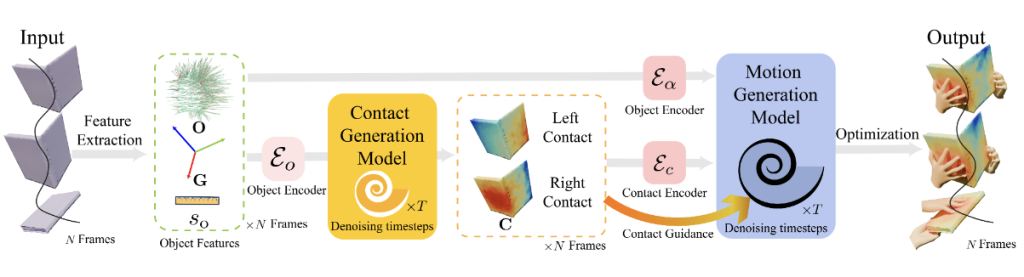
BimArt generates realistic 3D bimanual hand motions for articulated object manipulation given only object trajectories, requiring no reference grasps, coarse hand trajectories, or separate grasping/articulation modes.
- Method: Decomposes the task into contact generation, motion generation, and post-optimization, using distance-based contact maps and articulation-aware object encoding to produce diverse, physically plausible interactions.
- Limitations: Restricted to object categories seen during training, and requires a pre-given object trajectory as input.