Cooperative Foundation Models for Object Detection Active Learning
Experiments
Experimental Setup
We evaluate CoMODAL on two object detection benchmarks: DIOR for remote-sensing images and COCO for general object detection. We focus on one frequent target class in each dataset: vehicle for DIOR and person for COCO.
In the current experiments, we use RetinaNet R50 as the target object detector. CoMODAL is compared with common active learning baselines, including Random Sampling, Entropy-based Sampling, Coreset, PPAL, and DivProto.
Results
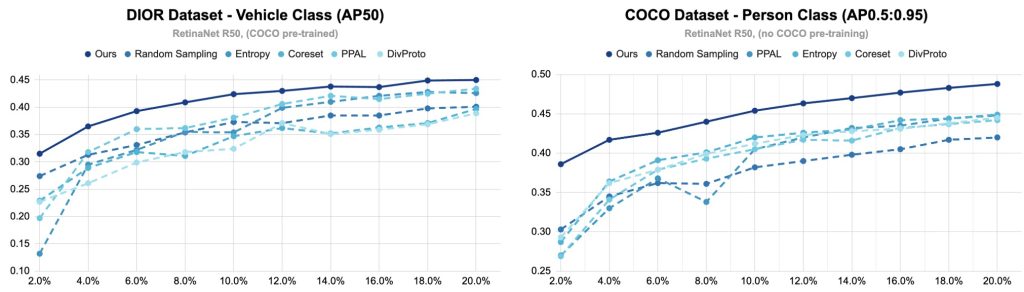
CoMODAL consistently outperforms the active learning baselines on both DIOR-vehicle and COCO-person under the same annotation budget. This shows that cooperative foundation models can improve sample selection for RetinaNet-based object detection.
On average, CoMODAL improves performance by 3.1% on DIOR-vehicle with RetinaNet and 4.3% on COCO-person with RetinaNet.
Automatic Annotation Efficiency
We also evaluate the quality of bounding boxes generated by the foundation-model annotation committee. For RetinaNet experiments, the generated boxes match a large portion of the ground truth boxes, with average matching rates of 87.14% on DIOR-vehicle and 87.65% on COCO-person.
Since humans only need to approve or reject proposed boxes, the annotation process becomes much faster than drawing boxes manually. Based on the estimated time difference between box drawing and binary verification, CoMODAL can substantially reduce query annotation time.
| Statistics Name | COCO (Person) | DIOR (Vehicle) |
|---|---|---|
| GTs average matching rate | 87.65% | 87.14% |
| FMs annotations approval rate | 31.08% | 26.41% |
Summary
The RetinaNet results show that CoMODAL improves active learning performance while reducing annotation effort. By combining foundation-model assistance with binary human feedback, the framework provides a more efficient way to train object detectors under limited annotation budgets.