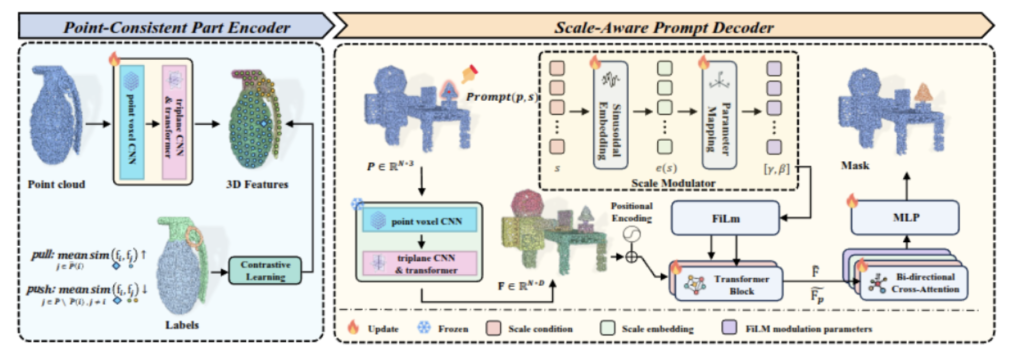
S2AM3D: Scale-Controllable Point Cloud Segmentation
Native 3D segmentation models often struggle with generalization due to data scarcity, while relying purely on 2D pre-trained priors can lead to inconsistencies across different 3D views. S2AM3D bridges this gap by offering scale-controllable part segmentation for 3D point clouds. It aggregates multi-view 2D features via a point-consistent part encoder paired with native 3D contrastive learning, resulting in globally consistent point features. A core contribution of S2AM3D is its scale-aware prompt decoder, which allows users to adjust segmentation granularity in real-time using continuous scale signals, making it highly robust when processing complex structures or parts with significant size variations.
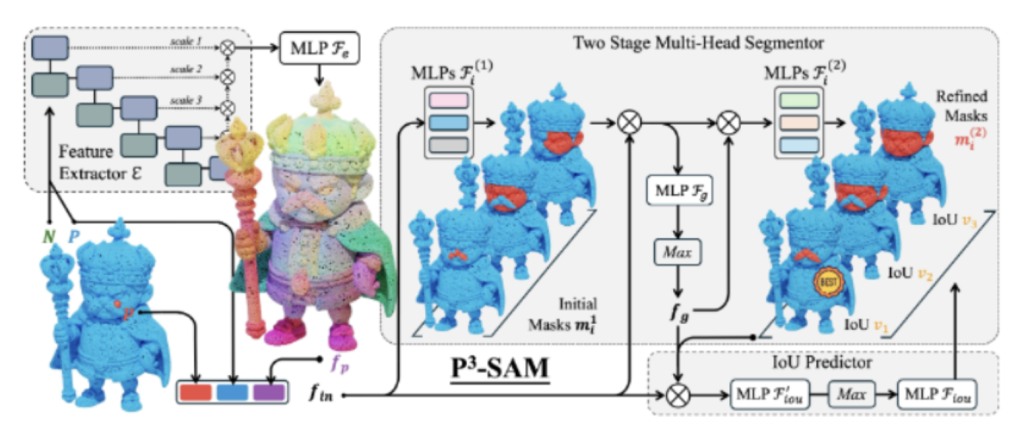
P3-SAM: Native 3D Part Segmentation
Segmenting 3D assets into constituent components is crucial for model reuse and downstream generation tasks. P3-SAM (Native 3D Point-Promptable Part Segmentation) brings interactive, prompt-driven segmentation to the 3D domain (Ma et al., 2025). Inspired by the 2D Segment Anything Model (SAM), P3-SAM takes a 3D point prompt and outputs relevant part masks along with Intersection over Union (IoU) predictions. Trained on a massive dataset of nearly 3.7 million annotated 3D models, the architecture leverages a dedicated feature extractor and multiple segmentation heads to fully automate the precise decomposition of complex 3D objects into individual parts (Ma et al., 2025).
OmniPart: Part-Aware 3D Generation
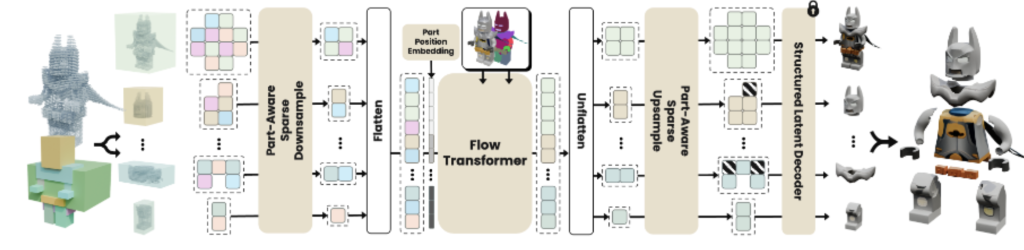
Creating 3D assets with explicit, editable part structures has historically been challenging, as many generative methods default to producing monolithic shapes. OmniPart addresses this by introducing a framework designed for high semantic decoupling and structural cohesion during generation (Yang et al., 2025). The pipeline splits the generation process into two stages:
Part Generation: Once the layout is planned, the framework generates the distinct 3D parts, ensuring that the decomposed components assemble cohesively while remaining semantically distinct (Yang et al., 2025).
Structure Planning: An autoregressive module generates a controllable sequence of 3D part bounding boxes. This step is guided by 2D part masks, allowing for user-defined control over part granularity without requiring rigid structural templates.