
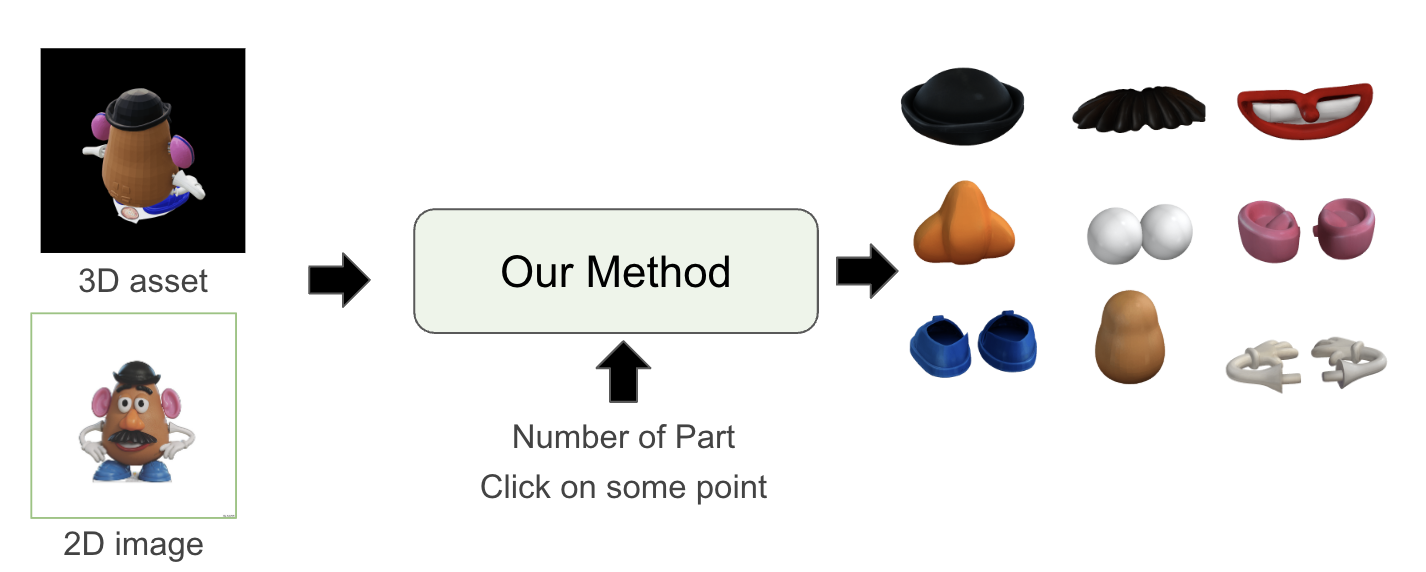
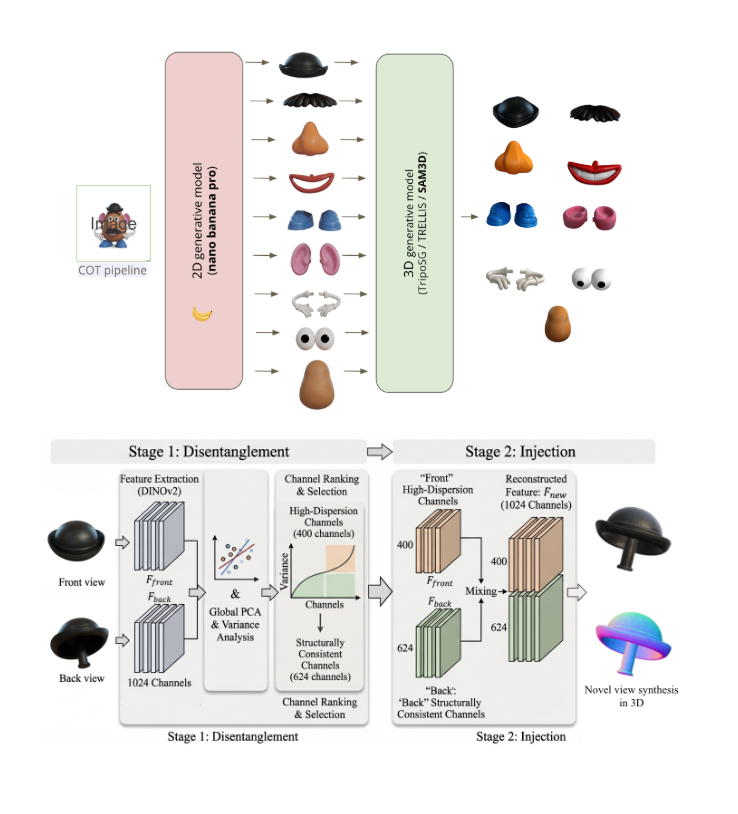
We present a novel, multi-stage framework for high-fidelity 3D generation combining a chain-of-thought compositional pipeline with DINO-based feature injection. First, vision-language models semantically decompose a complex input image into isolated parts, utilizing 2D generative models to isolate the components before reconstructing them via 3D generative models. To ensure multi-view consistency and structural coherence during this synthesis, we introduce a feature disentanglement technique using DINOv2. By performing channel-space PCA and variance analysis on the extracted features, we decouple stable, view-invariant structural channels from unstable, view-specific detail channels. This targeted injection mechanism allows us to seamlessly swap high-dispersion channels from a reference view into the structurally consistent channels of a target view, achieving zero-shot view-conditioning while preserving rigid geometric integrity.
Mathematical Formulation of DINO Feature Injection
The feature injection approach can be formally described using the following equations:
1. Feature Extraction:
Given an input view I_view, we extract the intermediate token features using DINOv2. The resulting feature map has a channel dimension C = 1024.
2. Variance Analysis (Disentanglement):
To separate global structure from view-specific details, we compute the spatial variance for each channel c across multiple views. Channels with high variance represent view-dependent details.
3. Channel Selection (Masking):
We define a channel-wise binary mask M based on a variance threshold tau. Channels exceeding this threshold are classified as “High-Dispersion” (M_c = 1), while the rest are “Structurally Consistent” (M_c = 0).
4. Targeted Feature Injection:
The novel feature map F_new is reconstructed by mixing the high-dispersion channels from the front/reference view with the structurally consistent channels from the back/target view using the mask M, where \odot denotes channel-wise multiplication.
Twenty Twenty-Five
email@example.com
+1 555 349 1806